
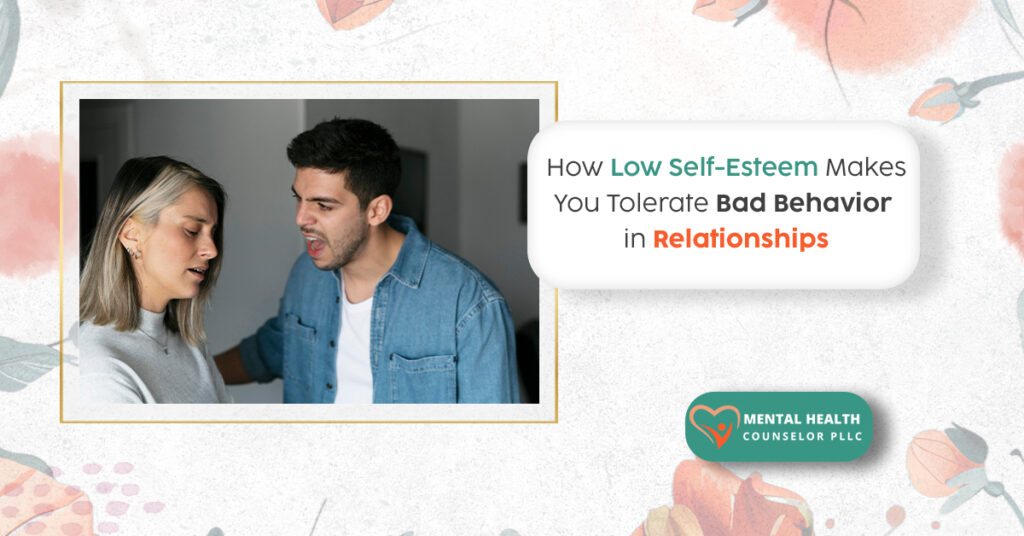
Have you ever looked at your relationship and wondered, “Why am I even putting up with this?”
Your partner is constantly:
- Canceling plans
- Making snide remarks about how you look
- Totally invalidating your feelings
Deep inside, you know it’s wrong. But you stay. You even find yourself making excuses for them.
It’s a painful place to be in.
More often than not, the reason runs much deeper in perception toward oneself. When self-esteem is low, so are our boundaries.
Learn what’s happening here. Also, learn how you can break the cycle.
The Psychology Behind Why We Settle
It’s not just about “loving too much.” There are actual psychological mechanisms at play that keep us glued to partners who don’t appreciate us.
The Comfort of Familiarity
When you have low self-esteem then you are uncomfortable with real praise or healthy love. It feels wrong because that is not the story inside your head.
The psychologists refer to it as cognitive consistency. We unconsciously try to find the places and people that fit our images of self.
You will, unconsciously, find partners who will support that in case you believe yourself to be a person who is hard to love or annoying.
Their criticism sounds like home. It makes an appeal to the voice of criticism already in your head.
It’s the Fear of “If Not Them, Then Who?”
Poor self-esteem just brings about a mentality of scarcity. You say to yourself that this is the best kind of relationship you are ever going to have.
Most likely, youranxious attachmentsits at the core of such thinking.
The fear of being abandoned is so engulfing that you are willing to put up with the bad treatment as long as you do not have to face being on your own.
Signs Your Self-Esteem Is Sabotaging Your Love Life
It’s not always apparent. Here is what it looks like:
- Over-apologizing. You end up apologizing for things that are not even your fault. You do it to keep the peace.
- Ignoring boundaries. You establish a boundary, they cross and you do not do anything about it.
- The fixer mentality. You think that if you just love them enough or change yourself in some way then they will finally treat you right.
- Seeking external validation. You rely entirely on their mood to determine your worth for the day.
How Cognitive Dissonance Plays a Role Here
Cognitive dissonance is one of the most difficult aspects of leaving a toxic relationship. It is the psychological uneasiness of believing in two things at the same time:
- “I love this person.”
- “This person hurts me.”
To reduce this discomfort, a person with low self-esteem will usually downplay the hurt rather than questioning the love. You gaslight yourself to make the reality bearable.
How to Rebuild and Reset
Changing this dynamic doesn’t start with changing your partner; it starts with rewiring your brain.
You have to begin rebuilding your internal locus of evaluation. Your worth comes from your own opinion of yourself. Not your partner’s approval.
Here’s what to do:
- Identify the voice. When you criticize yourself, pause. Is that your voice, or is it an echo of a past parent or partner?
- Practice “as if.” Be like you were someone who adores themselves. How would such an individual react when his or her partner chooses to cancel a date at the last moment and does not apologize? They would not plead.
- Seek professional support. You cannot necessarily read the label inside the bottle. You sometimes need an objective guide to see the patterns you are trapped in
Find Your Voice Again
You need not make your way out of this confusion single-handedly. The optimal way of making your relationships better is to repair your self-esteem.
Contact Mental Health Counselor PLLC today
Connect with a professional who will support you in restoring your value and your boundaries.
FAQs
Is the problem of low self-esteem the cause of relationship problems?
Absolutely. It is more likely to produce:
- A poor communication environment
- Jealousy
- Tolerance of toxic actions or behaviors
Is the relationship salvageable if one partner lacks self-esteem?
Yes. But it takes work.
The individual should build their self-esteem—often through therapy—to avoid relying on a partner to prove their value.
How do I start eliminating the tolerance of bad behavior?
Awareness. You have to be aware that your tolerance is a symptom of your self-esteem but not the extent of your love for your person.