
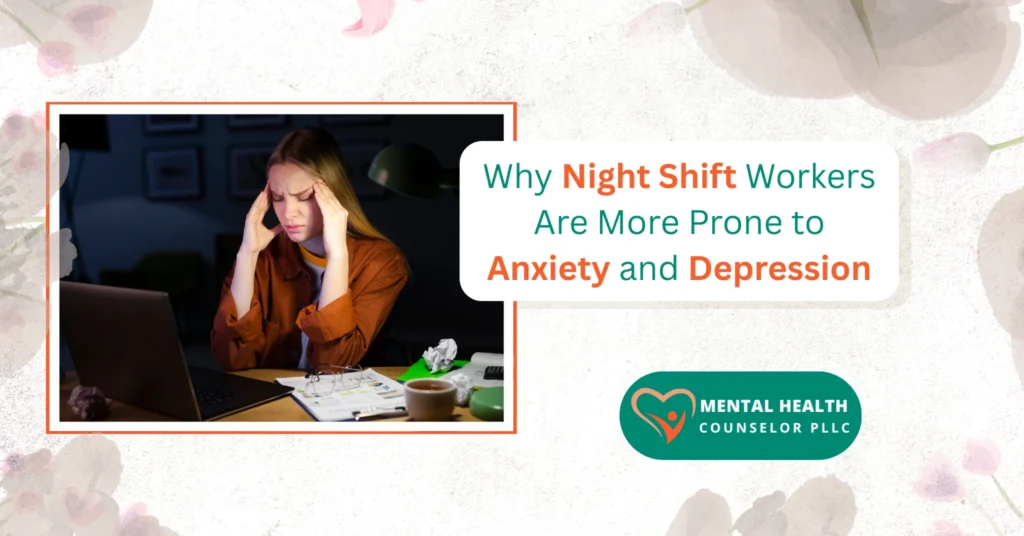
Most people don’t think twice about sleeping when it’s dark and waking when it’s light.
To night shift workers, that’s not an option, and the psychological price of such a trade-off is larger than many imagine.
This is not a matter of not being able to sleep. It is a matter of biology being driven somewhere it was not originally intended to go.
Your Brain Runs on a Clock You Can’t Turn Off
The circadian rhythm is something you must have heard about – the inbuilt 24-hour clock that your body follows to know when to be awake, hungry, or sleepy.
What the majority of people do not realize is that this clock does not simply control energy levels.
It also regulates the release of hormones, emotional regulation, and stimulation of the way your brain reacts to stress.
Working nights does not mean that you are just moving your schedule.
When you work nights, you’re not simply shifting your schedule.
You’re forcing your brain to stay alert during the hours it’s biologically wired to power down – and sleep during the hours it’s primed to be active.
That friction is constant. And over time, it wears on you in ways that go far beyond just feeling tired.
Research backs this up.
A meta-analysis of 28,431 workers discovered that depression and anxiety are among the overall risks of poor mental health brought about by shift work, which results in a 28 percent increase.
That’s not a small number.
The Sleep-Mood Loop Nobody Warned You About
When Sleep Departs, So Does Emotional Stability
Sleep isn’t passive downtime.
While you’re out, your brain is doing real work:
- Clearing out metabolic waste
- Consolidating memories
- Recalibrating the systems that keep your emotions steady
When night after night that process is interfered with, things begin to slip:
- The brain chemicals that are most closely related to mood, serotonin and norepinephrine, become disproportionate.
- The threat-detector of your brain (the amygdala) becomes hypersensitive, and small-stress triggers become catastrophic.
- The prefrontal cortex, which suppresses impulsive or anxious thoughts, is impaired.
When a night shift worker claims they’re on edge without any apparent reason or that they can’t stop spiraling over unimportant things, there is neuroscience behind it. It’s not a weakness.
The Isolation Piece That Is Not Given Enough Attention
Whereas the rest of the world is at dinner, at events, or simply relaxing on an evening, the night shift workers are reporting to work.
And month by month and year by year, that discrepancy silently gouges out your social life. Family rhythms don’t line up.
Friendships are costly in terms of time.
Even minor aspects, such as a spontaneous invitation to a holiday party, are turned into logistical issues.
Social isolation may lead to loneliness, depression, and relatively poor health among people.
Related – How Night Shift Work Affects Mental Health
Signs It Is Not All Tiredness
Exhaustion has a form of consumption that cannot be cured by sleep. On the off chance that you have been observing any of these, it seems worth attending to:
- You feel down even on your off days.
- The feeling of anxiety that is not related to something specific, but is constant.
- Pulling away from people without meaning to.
- Use of alcohol or caffeine, only to feel normal.
- The feeling of doing it by rote: at work, at home, everywhere.
- You have a feeling as though you have somehow been taken away.
These are not character weaknesses or indications that you are not the type that can handle the schedule. They are indicators of the fact that something has to change.
What Can Actually Help
Some adjustments do make a difference:
- Schedule your sleep – even when you are off work, attempt to sleep and get up at the same time. Rhythm is what your brain loves.
- Consider light exposure seriously – exposure to bright light immediately after getting up (or even unnatural light) is used to adjust your internal clock; put on blue-light-blocking glasses during your train or bus ride home.
- Guard one or two social moorings – a call once a week, a regular lunch, whatever will keep you attached to others that you love.
- Exercise your body – not to keep fit but because exercise is one of the surest mood stabilizers of which we can avail ourselves.
- Tell someone who understands – a therapist who knows about work-related stress and other mental issues involving sleep can provide more than a general coping behavior strategy.
We Can Assist
Our licensed therapists at Mental Health Counselor PLLC can assist individuals who are experiencing anxiety, depression, and the type of exhaustion that accumulates as life continues to demand more than you can offer.
We provide face-to-face sessions in New York, as well as secure tele-video sessions.
You can either book an appointment or call (212) 696-4717 – we are here when you are ready.
FAQs
Does working the night actually cause depression, or only exacerbate it?
Both are possible. To some individuals, shift work causes depression that was not previously experienced due to the disturbance of their sleep and social life. In others, it deepens an already existing weak spot. Anyhow, it is real and can be treated.
What is the duration of the impact of the night shift work on mental health?
There’s no fixed timeline. Some can perceive mood changes within weeks; others it develops gradually over months or years. The best thing about it is that the longer one is left without attention, the more difficult it is to undress it.
Is therapy useful when I cannot manage my work schedule?
Absolutely. You do not need to work on the outside of the situation and then come in afterwards. A good therapist will assist you to become tough emotionally and construct tools that will serve in your real life.
What about cases when I do not know whether I am getting depressed or it is only burnout?
Frankly, such a difference does not count as much as people believe. Both deserve attention.