
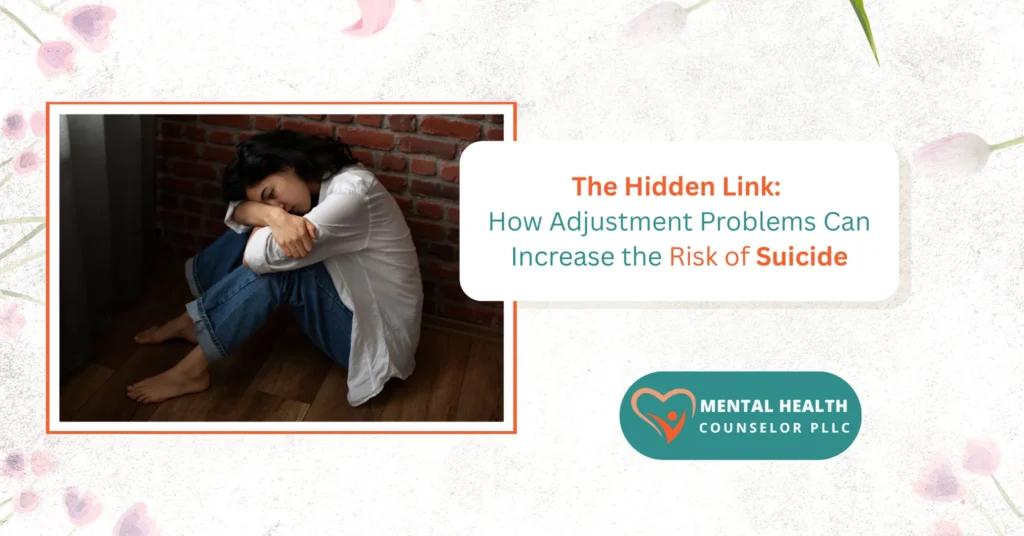
The Hidden Link: How Adjustment Problems Can Increase the Risk of Suicide
When people discuss suicide likelihood, they usually picture serious mood disorders like major depression or bipolar illness. Adjustment problems? Those rarely come to mind.They sound small, brief, like something one should simply power through. What Adjustment Disorders Actually Look Like An adjustment disorder arises when life presents a significant obstacle: Your emotional reaction exceeds what most individuals would ordinarily experience.We aren’t discussing mere sadness or tension. We mean a recognized clinical state where your ability to function actually deteriorates.The DSM-5 is precise: symptoms arise within three months of the source of stress, and they result in tangible impairment in your work, relationships, or daily routines.An individual managing an adjustment disorder might skip work entirely.They could pull away totally from companions. Their sleep rhythms might collapse, hunger might disappear, or intense nervousness may develop where none existed before.Frequent triggers include: What distinguishes this from simply “weathering a difficult period” is the intensity and the resulting interference. Your standard methods for managing pressure cease to be effective. Why This Connects to Suicidal Ideation The risk surfaces in how we downplay these conditions.Asserting “it’s merely stress” becomes perilous when someone is actually dealing with a mental health challenge needing specialized support.People with adjustment disorders have a higher risk of suicide, a point supported by evidence.The risk escalates sharply when the individual views their circumstances as permanent.When you lose your job at 55 and feel future employment is impossible, when your marriage dissolves and you are convinced you will face old age alone, when a medical finding redraws your entire path – that’s when despair solidifies. The Mental Processes at Play Adjustment disorders disrupt your thinking abilities. Stress floods your system, and suddenly, clear thought evades you.Figuring out solutions becomes unmanageable. You lose the capacity to envision alternatives or different outcomes. Clinicians label this cognitive inflexibility, and it poses a danger.The subsequent chain of events often involves: That final point is significant. Substance abuse clouds judgment and diminishes self-restraint, meaning someone with passing thoughts of self-harm might act upon them. Warning Signs That Demand Attention Certain shifts in behavior signal significant danger: That second indicator often misleads observers.Relatives may feel relieved when someone “appears improved,” unaware that this might signify they have resolved to end their life and feel settled in that choice. What Works Cognitive-behavioral therapy addresses the faulty thought patterns keeping someone immobilized.A therapist specializing in CBT will: This is not about forced optimism or seeing only the good side. It involves fundamentally altering how one processes their real-world experience.Certain people may need medicinal assistance, drugs, especially when manifestations are intense or if an accompanying issue, such as clinical depression exists.Nevertheless, pharmaceuticals by themselves will not sort out the adjustment disorder!The individual still needs to cultivate better methods for managing difficulty and process the impact of the event. Interpersonal Factors Connection with others serves as a buffer against suicide. When someone with an adjustment disorder maintains ties, their risk lessens. When they withdraw, the risk grows.This is why therapeutic approaches frequently incorporate methods to restore or sustain interpersonal networks, even when the person is inclined to withdraw.The initial problem might persist. You cannot reverse a separation or restore lost employment. But you can alter the way you move through that challenge.Are you grappling with a significant life transition that has thrown you off balance? Are thoughts of ending it all starting to surface? At Mental Health Counselor PLLC, our therapists work with adjustment difficulties, trauma, and the type of emotional distress that makes continuing seem uncertain.We offer face-to-face sessions in New York or virtual consultations wherever you are located. Get in touch now, because this state doesn’t have to be permanent. FAQs How long does an adjustment disorder typically last? Usually less than six months if the stressor resolves or you build improved coping mechanisms.However, if the stressor remains – such as continuous monetary strain or chronic health conditions – it can develop into a persistent adjustment disorder. Can positive events trigger adjustment disorders? Definitely. Any significant change that requires adjustment will trigger an adjustment disorder when it surpasses your present abilities to manage it. How does adjustment disorder differ from clinical depression? Adjustment disorder is closely related to a recognizable stress event and manifests itself within a period of three months.Major depressive disorder can appear without obvious triggers and involves broader symptoms affecting sleep, appetite, energy, and overall functioning across multiple life domains.
The Hidden Link: How Adjustment Problems Can Increase the Risk of Suicide Read More »